
Qualitative methodology
Online methods
Qualitative online methods offer flexibility.
Traditionally, many qualitative studies are conducted in face-to-face meetings, for example in physical focus groups, personal interviews at the respondent's home or by more anthropological and ethnographic methods such as shop-alongs, ethnoraids, observational studies etc.
Until Covid-19 in the spring of 2020, interest in web-based qualitative research in Denmark has been limited compared to other countries such as our neighbours in Sweden or the UK and US.
After the Covid-19 lockdown, online surveys are booming and everyone suddenly wants to connect with their target audiences online.
Analysis Denmark's qualitative team has been working with qualitative web-based surveys since 2008 and we have extensive experience with different online methods. The systems have become better and more user-friendly over time.
Qualitative online methods are a convenient and easy way to conduct qualitative online surveys that motivate and engage participants, and where the client can follow along as an observer and be in dialogue with the moderator along the way.



Benefits of qualitative online methods:
- You can gather target groups that are otherwise difficult to gather due to busyness, such as B-to-B, odd working hours, large geographical spread or as in the case of Covid-19 lockdown.
- Gives 100% anonymity. Particularly relevant in connection with a particularly sensitive topic or an internal employee survey where you want anonymity from colleagues and managers.
- Participation can be done from home, for example in the case of involving family members such as children and parents to discuss and evaluate a theme or product together.
- Opportunity to investigate products on-the-move or services that can't be “brought into” the focus group, e.g. a live concert, event, building or other ’unmanageable’.
- Particularly useful for focusing on young people. Often young people will find it easier to express emotions in writing rather than in person with people they don't know.
We work with different platforms including Zoom for Business, VisionsLive, InterVu and Revelation depending on customer needs.
Video groups
Web-cam groups work like physical focus groups, only online and with the use of web cam and microphone. We usually work with 6 participants per group. Group duration is typically 1 ½ hours and can include various test material, projective and creative exercises, polls, etc. Depending on the system, a simultaneous interpreter can be connected if necessary. Video from the group is recorded and the written and visual input is stored in a report.
Chat groups
Chat groups are a simple and effective way to get feedback on a theme, product or communication. Number of participants approx. 8-12. All communication is in writing in a closed chat forum lasting 1½-2 hours. As usual, you work from a set question guide. There is also room for the moderator and any observers to ask follow-up questions. The written dialogue is stored in an archive.

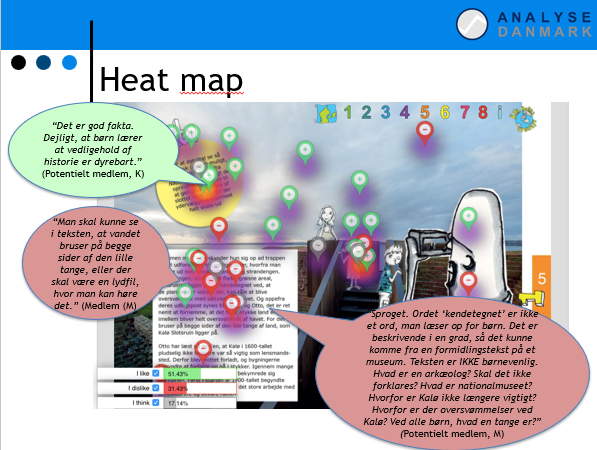
Image: Heat map from a pre-test of a children's book in a community with parents and children
Blog/Community
A blog or community has the same strengths and capabilities as a chat group, but typically runs for 2-3 days or longer with continuous feedback from respondents. There can be up to 30 participants per community depending on the number of questions and how much moderation is needed. New questions or exercises are posed daily for respondents to address or report on a development over time, e.g. testing a product, diary etc. A community is suitable when
- want to get respondents' feedback over time,
- Evaluate a product or service at home
- Keep written and visual diary entries.
Community also allows you to upload video, images and audio files.
On the go with tablet or smartphone
Most surveys can also be conducted on a smartphone or tablet. This allows for a response from the target audience in the form of visual on-location experiences, for example by uploading video, images and text wherever the user is. This could be on a shopping trip, a city tour or at home in the living room.
Read about the AIDS Foundation using mobile solution“My motivation to participate has been really high and I've been looking forward to seeing today's questions. A bit like a Christmas calendar that you look forward to opening.” Participant in qualitative mobile survey on youth culture.