
Three tips for sensitive interviews
Surveys where emotions are at stake place special demands on the design of the survey as well as on the interviewer. Marianne Hjelm Parastatis from Analyse Danmark has contributed to a new book on qualitative interview methods. Here are her three tips on what to look out for when conducting sensitive research.
Sensitive surveys is a common term for surveys that either focus on a taboo area or where the respondent has something at stake. It could be a survey of Danes' attitudes towards people living with HIV, or perhaps an internal employee satisfaction survey where it is crucial to guarantee the respondent's anonymity.
Marianne has contributed a chapter on sensitive research to the new book Qualitative Methods for Consumer Research edited by Thomas Bjørner. Here she offers three tips for those who want to conduct a good, sensitive survey.
Tip 1: Remember the good briefing
Prior to any analysis, it is necessary to prepare a relevant survey design. Here, it is crucial to provide a good briefing to the colleagues or collaborators who will be planning and conducting the survey.
The brief should outline the challenge you want the survey to address, how deeply you want to delve into the topic, the time horizon, resources and expected outcome of the survey. It's also important that the brief clarifies challenges such as recruitment of participants and what special considerations need to be made.
Tip 2: Utilise the toolbox
When conducting sensitive surveys, it's especially important to select techniques that get under the skin of respondents. These might be drawing techniques or association exercises, which can often help get the conversation going on a sensitive topic and put into words what is otherwise difficult to talk about.

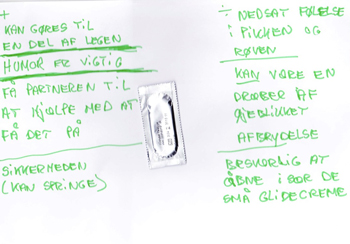
Examples from the qualitative toolbox: Timeline and use of physical props (here condom). From the survey of men who have sex with men (MSM) for the AIDS Foundation.
It is essential to consider the pros and cons of the toolbox options. For example, the in-person in-depth interview offers great opportunities to utilise physical props and to read the respondent's body language. However, some may feel more comfortable in an online forum where they can sit at home and be completely anonymous contributors.
Often it will be relevant to combine several techniques, but it depends on the study design.
Tip 3: Choose experienced interviewers
In sensitive research, it is particularly important to use an experienced interviewer who can keep a cool head and dare to ask probing questions - even when the topic is sensitive or taboo. It's also important to find an interviewer who has nothing personal at stake or is not coloured by their personal history or role.
This means that someone who has recently lost their spouse to cancer shouldn't be conducting interviews about Danes' knowledge of deadly diseases, just as an HR professional shouldn't be interviewing their colleagues about their wellbeing.
A good interviewer can distance themselves from the topic, but still create a familiar relationship with the respondents and spot new themes in the conversation. This is precisely the strength of qualitative methods.
Want to know more?
Do you need advice on sensitive surveys or other areas of qualitative analysis? Then you are welcome to contact Marianne Hjelm Parastatis.